Enterprise AI capability, taught to the standard your risk committee expects.
Aiskilljourney trains large organisations to use generative AI tools in everyday work with defined scope, documented controls and assessed outcomes. Programmes are written for enterprise conditions: licensed platforms, internal policies, and the scrutiny of risk, legal and audit functions. We work with human resources, learning, operations and compliance teams that need a repeatable way to raise capability without leaving staff to improvise at their desks.
Corporate learning on this subject is bound to the processes the organisation already runs, so examples, exercises and assessments refer to the work people actually do. Practice takes place inside the tools the organisation has already licensed, with the same access controls, logging and data handling rules that apply on an ordinary working day. Facilitators work from the organisation’s own policies on acceptable use, confidentiality and model selection, so classroom activity stays aligned with the rules staff must follow when they return to production systems.
The work is addressed to departments of fifty to five thousand people, including operations, customer service, finance, legal operations, procurement and internal audit. Compliance functions use the same programmes to establish a shared vocabulary for oversight. Learning leaders use them to replace ad hoc tool demonstrations with a structured path that can be scheduled, assessed and reported to a steering group.
Capability built inside the organisation’s own constraints
Aiskilljourney was established in 2026 to serve organisations that need staff to use generative AI with the same discipline they apply to any other production system. The brief is practical. People must know which tasks are in scope, which data may be entered, which outputs require human review, and how to record what they have done. Those questions are organisational questions. They cannot be answered by a generic tutorial that assumes an unconstrained personal account.
Each engagement begins with a written scope. The scope names the licensed tools, the business processes in play, the roles in the first cohorts, and the policies that already govern information handling. From that document the curriculum is adapted. Exercises use redacted or synthetic records that resemble the organisation’s own artefacts. Assessments ask participants to complete a task under the same constraints they will meet at work, then to explain the control they applied.
Workplace setting for applied sessions
Facilitators are briefed on the organisation’s acceptable-use rules before the first session. They do not introduce unsanctioned products, personal accounts or public models as a workaround. If a requested exercise would breach a data classification rule, the exercise is rewritten. That discipline is part of the service. It is also the reason programmes take longer to design than a catalogue course with a fixed slide deck.
Cohorts are kept small enough for observed practice. A typical group is twelve to twenty people from related roles, so discussion stays specific. Managers and individual contributors may be taught in separate rooms when their decisions differ. A manager’s session emphasises allocation of work, review of outputs and escalation. A practitioner’s session emphasises task framing, source handling and documentation of review.
Materials remain the organisation’s to retain. Slide sets, exercise packs, assessment rubrics and attendance records are handed over in a form that learning teams can store in their own systems. Aiskilljourney does not require a long-term content licence beyond the engagement unless the organisation later commissions a refresh. That arrangement keeps ownership clear for audit and for internal reuse.
The same method is used whether the first wave is a single department in Singapore or a coordinated series of cohorts across APAC offices. Local scheduling, language of business and tool tenancy are captured in the scope. The underlying quality standard does not change: defined scope, documented controls, assessed outcomes.
Curriculum
Eight role-based programmes, one quality standard
The catalogue is organised by the decisions people make at work rather than by vendor feature lists. Each programme has a stated audience, a duration, a set of assessed outcomes and a recommended follow-on. Full outlines sit on the programmes page. The summary below is for planning conversations with learning and risk sponsors.
Knowledge work
A foundation programme for staff who draft, summarise and research as part of their daily role. Participants practise scoping a task, selecting permitted sources, checking outputs against policy, and recording the human review they performed. Duration is typically two half-days with a short assessed exercise.
Analysts
A programme for people who work with structured and unstructured records. Emphasis falls on data classification, prompt construction that does not leak restricted fields, and methods for verifying figures and citations before they enter a report. Assessed work uses synthetic datasets prepared with the organisation.
Managers
A programme for team leads who assign work, review drafts and decide when a tool may be used. Sessions cover supervision, quality sampling, workload design and the language to use when declining an unsafe request from a report. Duration is one day, with a written decision exercise.
Operations
A programme for process owners and operations staff who handle volume work. Content addresses standard operating procedures, exception handling, customer-facing language and the points at which automation must stop for a named reviewer. Practice uses the organisation’s licensed workspace.
Risk and compliance
A literacy programme for second-line functions. It maps common generative AI failure modes to existing control families: confidentiality, accuracy, fairness of treatment, record keeping and third-party terms. Participants leave with a checklist they can apply to a real process under review.
Internal audit
A programme for auditors who will test AI-enabled processes. It covers evidence they should expect to see, sampling approaches for model-assisted work, and interview questions for process owners. No proprietary audit methodology is imposed; the material is designed to sit beside the organisation’s own standards.
Secure tool use
A short, practical course on tenancy settings, logging, retention, plugin and connector risk, and the difference between approved enterprise licences and consumer accounts. It is often scheduled as a prerequisite for other programmes when tool access is being widened.
Executive briefing
A half-day session for sponsors and steering groups. It sets out what capability programmes can and cannot achieve, the evidence a board should request, and the decisions that remain with management. It is educational. It does not constitute legal or regulatory advice.
Programmes may be combined into a pathway for a function. A typical operations pathway is secure tool use, knowledge work, then operations, with a managers session for supervisors. A typical second-line pathway is the executive briefing, risk and compliance, then internal audit. Sequencing is agreed in the scope so that assessments build on one another rather than repeating the same exercise in different rooms.
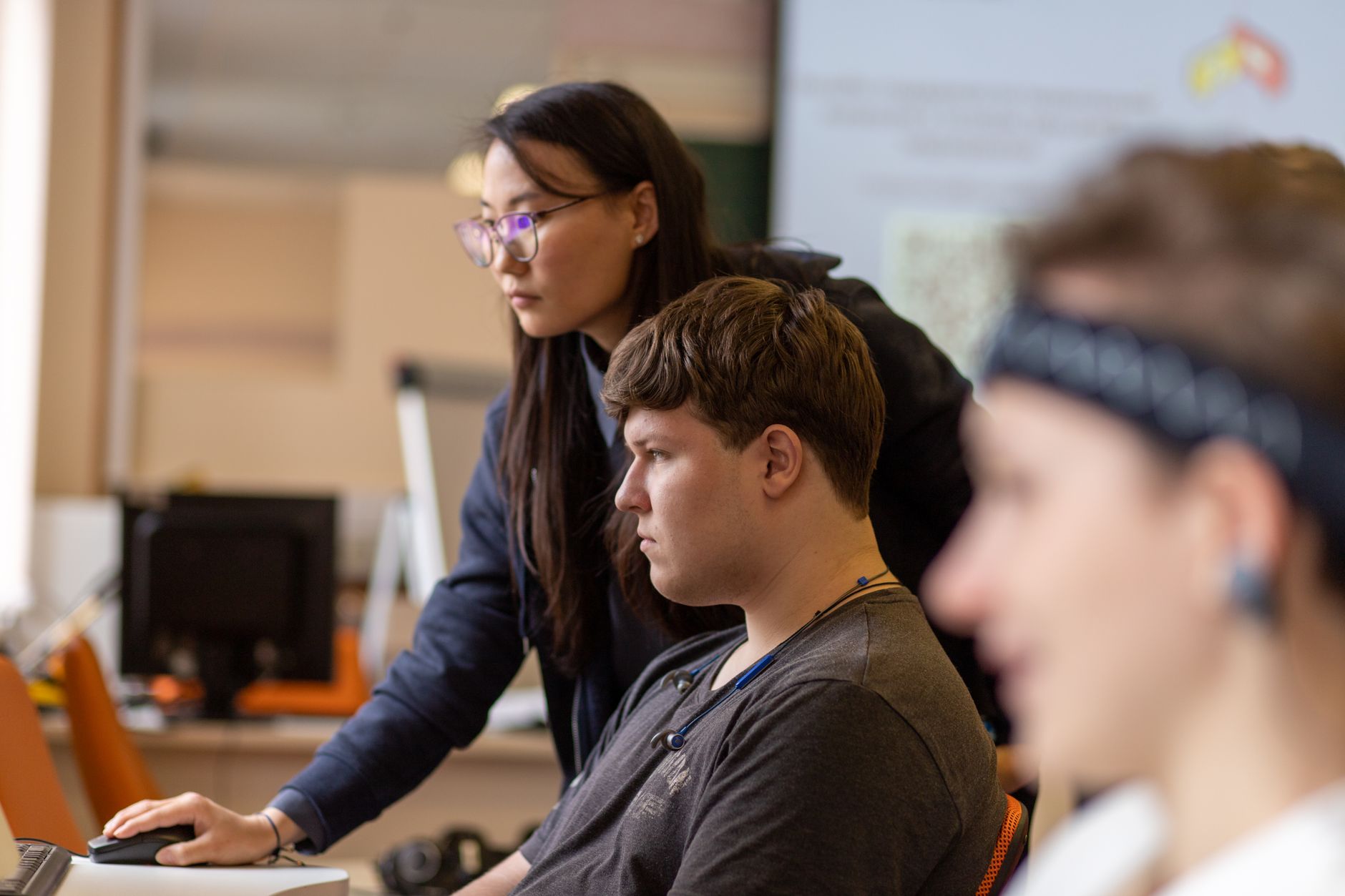
Session with a client team
How work proceeds
An engagement has a beginning, a middle and a close that can be audited
Delivery is described in full on the delivery page. The outline here is for sponsors who need to know what they are commissioning. Work is organised in stages with named artefacts. Nothing is left as an informal conversation that later cannot be reconstructed.
Discovery interviews with learning, the process owner and a risk or compliance counterpart. Output: a scope note covering tools, roles, policies and success measures.
Curriculum adaptation and exercise design, including any synthetic data. Output: a facilitator guide, participant materials and an assessment rubric signed as fit for the organisation.
Cohort delivery, on site or in the organisation’s licensed remote rooms. Output: attendance, observed practice notes and completed assessments.
Handover of materials, results and recommended next cohorts. Output: a close report the steering group can file.
Facilitation is in English, in the register used in Singapore professional services and regional headquarters. If a cohort works primarily in another language of business, that fact is recorded in discovery so that examples and spoken pace can be adjusted. Translation of materials is a separate commissioned task.
Capability is measured by what staff can do under policy, in the tools the organisation already licences, with a record that a reviewer can inspect.
Oversight
Governance literacy sits inside every programme
Generative tools change how quickly text, code and summaries can be produced. They do not change the organisation’s duties regarding confidentiality, accuracy, fair treatment of customers, or the integrity of records. Aiskilljourney treats those duties as teaching content, not as an appendix. The governance page sets out the literacy topics in more detail.
Participants are taught to identify personal data, commercially sensitive material and material covered by client confidentiality before they enter a prompt. They practise rewriting a task so that it can be completed with permitted inputs. They are shown how to treat model output as a draft that requires a named reviewer when the decision has legal, financial or customer impact.
Where the organisation already maintains an acceptable-use policy, that document is the classroom standard. Where the policy is still being written, the programme can include a working session that lists decisions the policy must settle: approved tools, logging, retention, prohibited use cases, and the route for exceptions. Aiskilljourney does not publish a model policy for the organisation to adopt unseen. The working session produces a list of questions for the organisation’s own authors.
Second-line colleagues are invited to observe at least one cohort in the first wave. Observation is useful for two reasons. It shows whether staff understand the controls as written. It also shows whether the controls as written can be followed in the time available for the task. Findings from observation are recorded in the close report so that process owners can adjust procedures if needed.
Logging and retention are treated as operational facts. If the licensed tool records prompts, participants are told what is recorded and who may read it. If the tool does not record prompts, participants are taught what local record the organisation expects instead. Ambiguity on this point is a common source of later incident reports, so it is settled in discovery rather than left to classroom improvisation.
Geography
Singapore base, APAC organisations
Aiskilljourney operates from 5 Temasek Boulevard, #23-06, Suntec Tower Five, Singapore 038985. Client organisations are headquartered in Singapore or run regional operations from Singapore into the wider APAC region. Travel to other offices is arranged when a cohort cannot reasonably join a Singapore session, subject to the scope note.
Sectors currently in active delivery include banking and financial services operations, telecommunications, professional services, healthcare administration, public bodies with commercial arms, and large industrial groups with regional shared-service centres. The sectors page describes how programmes are adapted for those settings without disclosing client names.
Sponsors are entitled to know whether a programme changed what people can do. Aiskilljourney reports on attendance, assessment results against the agreed rubric, and a sample of anonymised work products from the assessed exercise. The method is described on the evidence page. Satisfaction scores and unnamed testimonials are not used as a substitute for those artefacts.
Applied practice
An assessment is written against behaviours that can be observed in a short exercise: the participant scoped the task, selected permitted inputs, produced an output that a reviewer could check, and recorded the review. Rubrics are shared with the organisation before the first cohort so that there is no surprise at the close. If a participant does not meet the standard, the close report states the number and the recommended remedy, which may be a repeat session or additional supervised practice in the line.
Where the organisation already runs a learning management system, completion records can be formatted for upload. Aiskilljourney does not operate the organisation’s system of record. Ownership of attendance and assessment data remains with the organisation once handed over.
Follow-up observation, typically four to eight weeks after a cohort, is available as a defined extra. A facilitator samples live work with the process owner’s permission and notes whether classroom behaviours are present on the job. The note is factual. It is not a performance appraisal of named individuals.
Further reading for sponsors is collected on the briefings page. Those notes cover planning questions: cohort size, sequencing, tool tenancy, and the evidence a risk committee typically asks to see. They are dated 2026 and written in the same register as this site.
Quality control inside Aiskilljourney is itself documented. Facilitator guides are versioned. Exercise packs are reviewed against the organisation’s scope before use. A second reader checks that assessments can be marked consistently. After each engagement, the close report is filed with the version numbers of the materials used. If the organisation commissions a later refresh, the previous versions remain available for comparison.
This approach takes more calendar time than a single webinar. It is the approach that stands up when an internal auditor asks what staff were taught, on which date, against which policy, and how competence was judged. Organisations that need only a product demonstration are better served by their software vendor. Organisations that need a defensible enablement record are the intended readers of this site.
Common planning mistakes are listed so they can be avoided. Mixing unrelated roles in one room dilutes the exercises. Launching cohorts before the acceptable-use policy names approved tools produces conflicting instruction. Measuring success only by attendance produces a full room and an empty evidence file. Each of those issues is cheaper to correct in discovery than after the first week of delivery.
Questions that fall outside training, including vendor selection, model risk methodology and contractual terms with model providers, are directed back to the organisation’s own specialists. Facilitators will discuss how those decisions affect classroom practice. They will not substitute for procurement or for legal review.
Start here
Briefings, practical questions, and how to commission work
A first conversation is a briefing, not a sales theatre. The useful inputs are the licensed tools, the functions in the first wave, the policies already in force, and the date by which a steering group expects a report. With those facts, Aiskilljourney can say whether a catalogue programme fits, what must be adapted, and how many cohort days are realistic.
Enquiries are received at hello@AISkillJourney.eu and on +65 6337 2914, Monday to Friday, 09:00–18:00 Singapore time. The contact page includes a written form. Responses are sent within one business day. If the work is outside our scope, that will be stated plainly so that time is not spent on a proposal that cannot be delivered.
Frequently asked planning questions, including cohort size, remote delivery and material ownership, are collected in the FAQ. Legal pages covering privacy, terms and cookies sit in the footer of every page.
This site stores a small preference cookie if you accept the banner, so that the notice is not shown on every visit. Essential cookies needed to send the enquiry form may be set by the server. Read the Cookies page for the full list and retention periods.